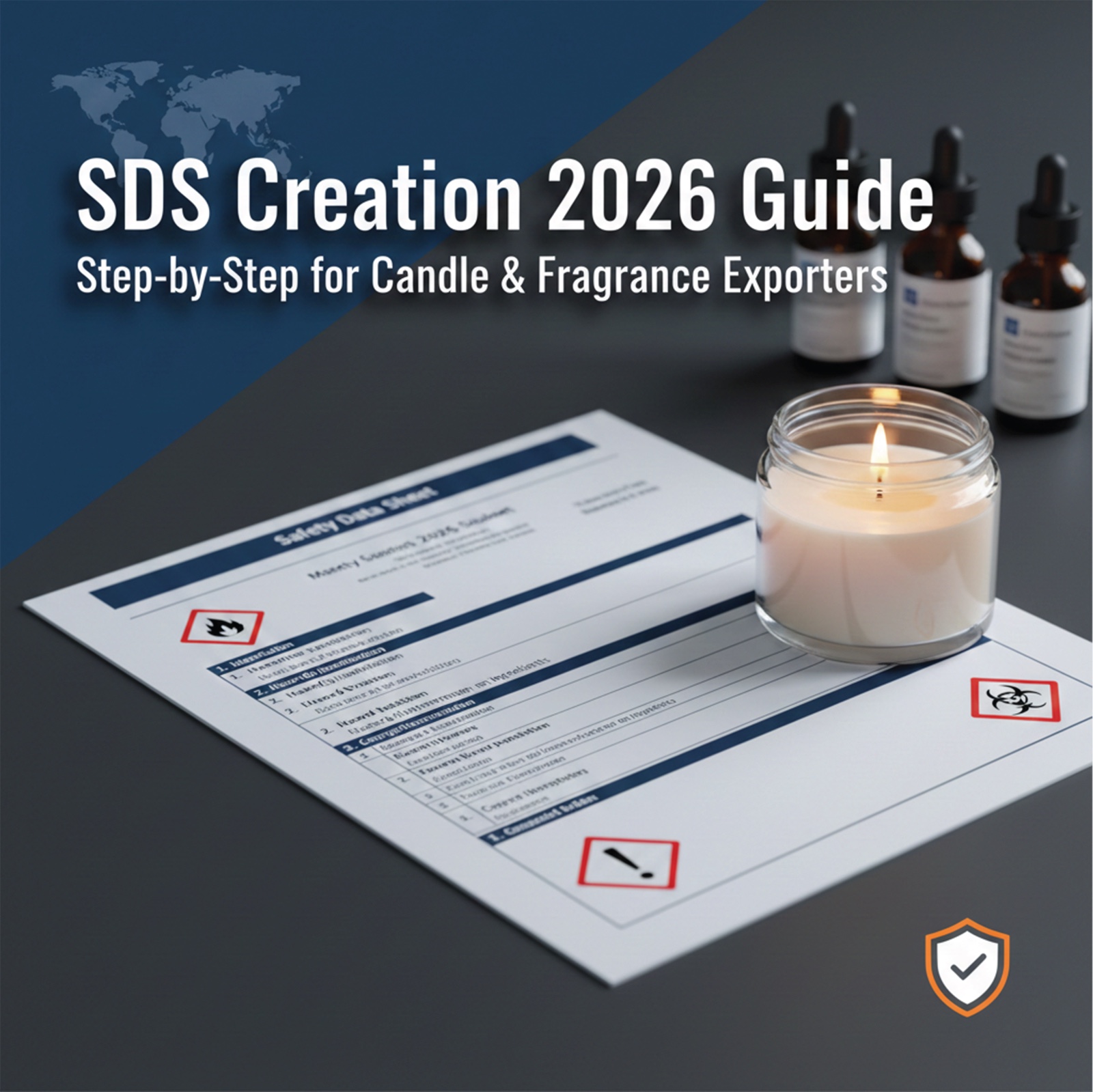
Selling candles, fragrance oils, reed diffusers, wax melts, room sprays, or other home fragrance products into the United States requires more than attractive packaging and compliant consumer labels. One of the most frequently requested technical documents by US buyers, distributors, and major marketplaces is a properly prepared Safety Data Sheet (SDS) that meets the OSHA Hazard Communication Standard (aligned with GHS).
This guide explains the US requirements for GHS/OSHA SDS for candle and home fragrance products, when the document is needed, and why Amazon and other marketplace retailers increasingly insist on it.
Why an OSHA SDS Matters for the US Market
The Occupational Safety and Health Administration (OSHA) Hazard Communication Standard (29 CFR 1910.1200) requires chemical manufacturers, importers, and distributors to provide Safety Data Sheets for hazardous chemicals. Most scented candles, fragrance oils, and home fragrance mixtures fall under this requirement because of common classifications such as:
- Flammable liquids or solids
- Skin sensitisation
- Eye irritation
- Hazardous to the aquatic environment
Even when a finished candle is sold only to consumers, the fragrance oil or concentrate used in manufacturing, and often the finished product itself when supplied to professional or industrial users, still needs an SDS. US importers, distributors, and private-label brands routinely request the SDS before placing orders. Without it, shipments can be delayed, rejected, or blocked at the border.
GHS and OSHA – What Is the Difference?
The Globally Harmonized System (GHS) provides the international framework for classifying chemicals and communicating hazards. OSHA adopted GHS principles into its Hazard Communication Standard.
In practice:
- An OSHA SDS follows the mandatory 16-section format and uses GHS classification criteria, pictograms, signal words, hazard statements, and precautionary statements.
- For products destined for the United States, the SDS must be prepared (or verified) according to OSHA’s specific implementation of GHS.
- Language, emergency contact information, and certain section details must meet US expectations.
When Is an SDS Required for Candle and Home Fragrance Products?
You generally need an OSHA-compliant SDS in these situations:
- Fragrance oils, essential oil blends, or aroma compounds supplied to US manufacturers or private-label brands
- Finished scented candles, wax melts, reed diffusers, or room sprays classified as hazardous under GHS/OSHA criteria
- Products sold to professional users, retailers, or distributors who request hazard communication documents
- Any mixture that meets the criteria for physical, health, or environmental hazards
Many “natural” or “clean” fragrance products still require an SDS because of flammability or skin sensitisation from fragrance ingredients.
Amazon and Other Marketplace Retailers – Why They Ask for SDS
Amazon, Walmart Marketplace, Etsy (in certain categories), and other major US platforms have tightened product safety and compliance expectations. Sellers frequently encounter the following scenarios:
- Amazon requests an SDS during product approval, especially for scented candles, fragrance oils, essential oils, and home fragrance items listed under chemical or flammable product categories.
- Account health or compliance teams may ask for the SDS when a product is flagged for safety review.
- Private-label or wholesale buyers who sell on Amazon often require the SDS from their suppliers before listing products.
- Some fulfilment centres and third-party logistics providers request SDS documentation for inventory that may be considered hazardous.
Having a ready, product-specific OSHA SDS significantly reduces delays and the risk of listing suppression or account warnings. Many successful Indian exporters of fragrance and candle products now treat the SDS as a standard part of their US market documentation package alongside the IFRA Certificate and Allergen Declaration.
Key Elements of a Compliant OSHA SDS for Fragrance Products
A properly prepared SDS for candle or home fragrance products typically addresses:
- Identification – Product name, recommended use, supplier details, and emergency contact
- Hazard Identification – Accurate GHS classifications, pictograms, signal word, and hazard statements relevant to the mixture
- Composition – Disclosure of hazardous ingredients within concentration ranges (respecting confidential business information where applicable)
- First-aid, Fire-fighting, and Accidental Release Measures
- Handling and Storage – Specific guidance for flammable or sensitising materials
- Exposure Controls and Personal Protection
- Physical and Chemical Properties – Including flash point where relevant
- Stability, Reactivity, Toxicological, and Ecological Information
- Disposal, Transport, and Regulatory Information
- Other Information – Preparation date and revision history
Classification must be based on the actual formulation, not generic templates. Using incorrect classifications or outdated GHS versions is one of the most common reasons US buyers reject SDS documents.
Common Problems Exporters & Retailers Face
- Submitting an SDS prepared only for the EU market
- Missing or incorrect flash-point data for fragrance oils
- Incomplete allergen or sensitiser information
- Using outdated OSHA/GHS revisions
- Providing the same SDS for multiple products with different compositions
- Providing Supplier's Fragrance oil SDS instead their finished product SDS by just changing the product names
These issues often surface only after a US buyer or Amazon compliance request, creating last-minute pressure.
How Professional SDS Authoring Solves the Problem
Accurate OSHA SDS authoring starts with a detailed review of the product formulation, intended use, and target market. The document is then prepared specifically to meet OSHA’s 16-section requirements and GHS classification criteria applicable in the United States.
When paired with a matching IFRA Certificate of Conformity and Allergen Declaration, the SDS forms a consistent documentation set that US importers, distributors, and marketplace sellers expect.
Next Steps for Manufacturers, Retailers and Exporters
If you supply or plan to supply candles, fragrance oils, or home fragrance products to the United States whether through Amazon, other marketplaces, distributors, or private-label partners — an up-to-date OSHA SDS is no longer optional.
Need a product-specific GHS / OSHA SDS for your candle or fragrance range?
JAPAG Regulatory Solutions prepares technically accurate OSHA SDS documents tailored to fragrance oils, scented candles, and home fragrance products for the US market.
Talk to Our Regulatory Experts to discuss your formulation and receive a clear quotation.