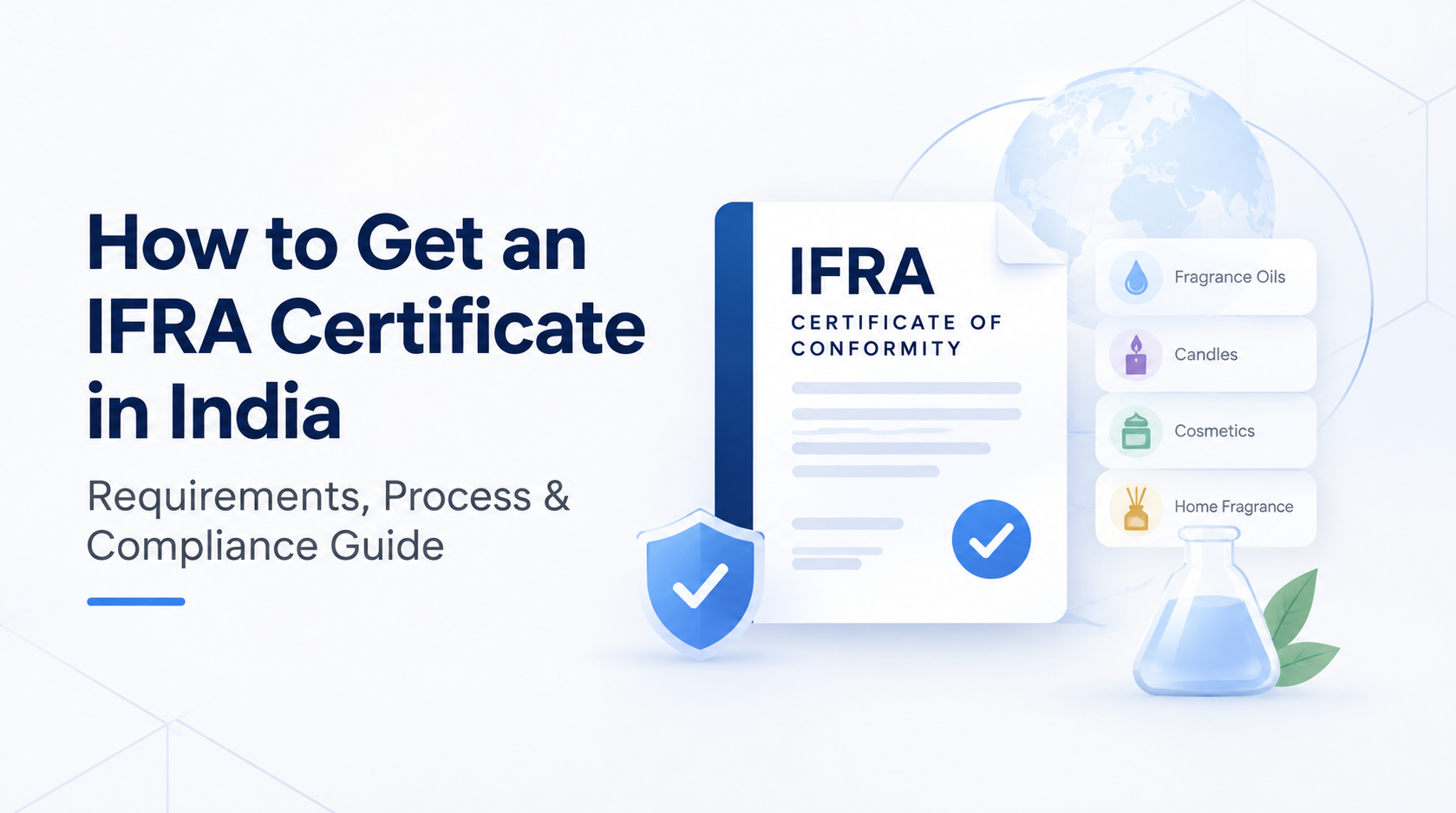
IFRA Compliance Explained: Standards, Categories & Fragrance Usage Limits
Fragrance compliance involves more than selecting an ingredient, blending a fragrance, or obtaining a certificate from a supplier. Manufacturers and brands need to understand how fragrance ingredients are restricted, how intended product use affects permitted concentrations, and what supporting documentation is required for their products and target markets.
The International Fragrance Association (IFRA) publishes Standards that establish requirements for the safe use of fragrance ingredients in specified applications. These Standards are widely used across the fragrance supply chain, including by fragrance houses, perfume manufacturers, candle brands, cosmetics businesses, and home-fragrance companies.
However, IFRA compliance is not the same as complete product regulatory compliance. An IFRA Certificate of Conformity addresses conformity with applicable IFRA Standards; it does not replace a finished-product safety assessment or applicable legal requirements.
This guide explains how IFRA compliance works, how product categories and fragrance usage limits are determined, what formulation information is needed, and how to approach fragrance documentation responsibly.
1. What Is IFRA Compliance?
IFRA compliance refers to conformity with the applicable requirements of the International Fragrance Association Standards for a specified fragrance material or mixture and its intended use.
The Standards are developed through a scientific assessment and industry standard-setting process. Depending on the material and the available evidence, an IFRA Standard may prohibit a material, restrict its use, or specify conditions that must be met.
The three principal types of IFRA Standards are:
- Prohibition: The use of a specified fragrance material is prohibited under the applicable Standard.
- Restriction: The material may only be used under defined conditions, including quantitative limits or limitations on the applications in which it may be used.
- Specification: The material must meet specified conditions, such as purity or other material characteristics.
The applicable requirement depends on the particular material and Standard. It is therefore not sufficient to check only the fragrance's trade name or the general product category.
The official IFRA Standards guidance explains the purpose and application of these requirements.
2. What Is an IFRA Certificate of Conformity?
An IFRA Certificate of Conformity is a document used to declare that a specified fragrance mixture conforms to the applicable IFRA Standards for its intended use.
It is typically prepared by the company that formulates and supplies the fragrance mixture, within the context of its relationship with the customer.
A Certificate of Conformity should identify the relevant fragrance mixture and communicate its conformity for the specified intended use. It should be supported by sufficient formulation information and an appropriate assessment.
There are several important limitations to understand:
- IFRA itself does not issue individual Certificates of Conformity.
- A certificate for one fragrance mixture should not automatically be applied to another formulation.
- Conformity for one intended application does not automatically establish conformity for every other application.
- The certificate does not replace a finished-product safety assessment.
- The certificate does not establish compliance with every law or regulation in the destination market.
IFRA also generally does not issue conventional Certificates of Conformity for individual raw materials in the same way as for fragrance mixtures. Relevant conformity information for raw materials may instead be communicated by the supplier.
Where a fragrance supplier cannot complete the assessment internally, a competent external service provider may be able to assist with the relevant documentation.
Official reference: IFRA – Certification of Conformity with the IFRA Standards.
3. How Do IFRA Categories Work?
IFRA Standards use categories to distinguish different finished-product applications according to their intended use and relevant exposure conditions.
The category determines which requirements and quantitative limits must be considered when assessing a fragrance mixture.
Examples of product applications include:
- Fine fragrances and perfumes.
- Leave-on cosmetic products.
- Rinse-off personal-care products.
- Products with specific exposure conditions, including certain lip-related applications.
- Candles and wax melts.
- Reed diffusers and other air-care products.
- Other fragranced consumer products.
These examples are illustrative, not a substitute for the official category guidance.
A product's marketing description does not determine its IFRA category on its own. Two products that both contain fragrance may require different categorisation because they are used differently.
For example, a reed diffuser and a room spray should not automatically be assigned to the same category. Their use conditions differ, and the applicable category must be checked against the current IFRA-RIFM guidance.
The same principle applies to products marketed for multiple uses. If a fragrance mixture is intended for several applications, the applicable limits must be reviewed across the relevant categories.
How to identify the correct category
- Establish the precise finished-product application.
- Review the current IFRA-RIFM Guidance for the Use of the IFRA Standards.
- Consider the product's intended use and relevant exposure conditions.
- Verify the applicable category before calculating or communicating a maximum use level.
- For unusual or unclear applications, obtain an appropriate technical categorisation review.
The finished-product manufacturer remains responsible for determining the correct application and ensuring that the product meets the relevant requirements.
4. How Are Maximum Fragrance Usage Limits Determined?
One of the most important parts of IFRA compliance is establishing the maximum permitted fragrance concentration for the intended finished-product application.
Quantitative limits in IFRA Standards are expressed as upper concentrations in the finished consumer product, not simply as percentages within the fragrance concentrate.
This distinction matters because a fragrance mixture may contain one or more ingredients subject to restrictions. The amount of each relevant ingredient contributed to the finished product depends on its concentration in the fragrance mixture and the dosage of that mixture in the final formulation.
Understanding the calculation
A simplified illustration can help explain the principle.
Suppose a fragrance concentrate contains a restricted constituent at 4% by weight. If the fragrance concentrate is used at 10% by weight in a finished product, the constituent's contribution from that fragrance concentrate would be:
4% × 10% = 0.4% in the finished product.
This is an illustrative calculation, not an IFRA usage recommendation. Actual assessments must consider the applicable Standard, other relevant sources of the constituent, and the correct basis for the formulation calculation.
Why the most restrictive applicable requirement matters
A fragrance mixture may contain several ingredients subject to different requirements.
The maximum usage level for a particular application must account for all relevant restrictions and conditions. The lowest applicable limit may determine the overall permitted use level.
This means that the maximum usage level cannot reliably be established from one ingredient, a generic category chart, or the fragrance oil's name alone.
For a complete assessment, the following information may be needed:
- The quantitative composition of the fragrance mixture.
- The identities of relevant restricted constituents.
- The intended finished-product category.
- The applicable IFRA Standards and conditions.
- Information on relevant contributions from other ingredients or raw materials.
For additional technical detail, refer to IFRA's guidance on using the Standards.
5. Why Formulation Data Matter in IFRA Compliance
The reliability of an IFRA assessment depends on the quality and completeness of the information available.
A fragrance's commercial name, marketing description, or general product specification does not establish its full chemical composition.
A Safety Data Sheet can be useful, but it may not disclose every constituent or the precise concentration of each ingredient needed for a quantitative assessment.
Depending on the fragrance and its intended use, the assessor may need:
- Chemical identities and CAS numbers, where applicable.
- Quantitative ingredient information.
- Supplier technical documentation.
- Relevant information on natural complex substances.
- Existing IFRA documentation.
- Details of formulation changes.
- The intended application and fragrance dosage.
Where proprietary formulation data are involved, the fragrance supplier may provide the required information directly to the competent assessor under appropriate confidentiality arrangements.
If adequate information is unavailable, the limitations should be identified rather than assuming that the fragrance conforms.
6. IFRA Compliance for Natural Fragrance Ingredients and Essential Oils
Natural ingredients are not automatically exempt from IFRA requirements.
Essential oils and other natural complex substances can contain multiple constituents, some of which may be subject to individual IFRA Standards.
Consequently, an assessment may need to consider both requirements applicable to the natural material itself and restrictions relating to relevant constituents.
The composition of natural materials can vary according to factors such as botanical source, origin, extraction method, and material quality. Where the available composition data are insufficient, the assessment may need additional supplier information or appropriate analytical data.
IFRA provides an Annex on Contributions from Other Sources and related guidance to help address relevant constituent contributions from natural complex substances.
For businesses working with essential oils, the practical lesson is straightforward: do not assume that a natural origin establishes unrestricted use or that a generic supplier declaration covers every intended application.
7. IFRA Compliance for Candles, Perfumes, Cosmetics and Home Fragrances
Different finished-product applications require different assessments. The same fragrance concentrate may have different maximum permitted use levels depending on its intended application.
Perfumes and fine fragrances
Fragrance mixtures intended for perfumes and similar products must be assessed against the applicable requirements for the intended application. The permitted use level should be established from the relevant Standards and formulation data rather than from a generic industry recommendation.
Cosmetics and personal-care products
Products such as creams, lotions, soaps, and other personal-care products may involve different exposure conditions. The correct category must be established for the actual application.
IFRA conformity does not replace applicable cosmetic safety assessments, ingredient restrictions, or labelling obligations.
Candles and wax melts
Fragrance mixtures used in candles and wax melts must be assessed for their intended applications under the relevant IFRA guidance.
A fragrance's maximum use level should not be assumed to be identical for every candle formulation or every other fragranced product. Separate product safety and applicable regulatory considerations may also apply.
Reed diffusers and room fragrances
Air-care products need appropriate categorisation according to their intended use.
Do not assume that all room-fragrance products fall under one category. In particular, a product applied to the air and a product that releases fragrance through passive evaporation may require different categorisation.
Multiple-use fragrance mixtures
If a fragrance mixture is intended for more than one finished-product application, each intended use must be considered.
Where multiple categories apply, the relevant limits must be compared for the formulation. A fragrance mixture's use level for one application should not automatically be carried over to another.
8. Understanding IFRA Amendments and Updates
IFRA Standards are updated through a process that involves scientific assessment, consultation, review, and publication.
An amendment may introduce new Standards, revise existing requirements, or update guidance and supporting documentation.
Businesses should distinguish between a proposed change, a final notification, and the relevant implementation period.
As of October 2026, the public consultation for the 52nd Amendment has closed. IFRA published its End of Consultation Letter on 31 August 2026, and the final notification is expected in January 2027. The announced implementation periods are expected to be 11 months after notification for new creations and 30 months for existing creations, subject to the final notification and applicable provisions.
These are forthcoming requirements, not a basis for treating every proposed change as already in force.
For businesses maintaining existing fragrance mixtures, the appropriate approach is to:
- Monitor official IFRA announcements.
- Review the applicable final Standards and implementation provisions when published.
- Identify which formulations may be affected.
- Obtain updated supplier information where necessary.
- Reassess existing conformity documentation where a change affects its applicability.
Do not rely solely on a certificate's issue date or assume that every amendment affects every fragrance mixture in the same way.
Official update: IFRA publishes End of Consultation Letter for the 52nd Amendment.
9. IFRA Certificate vs SDS vs Fragrance Allergen Declaration
These documents are frequently requested together, but they serve different purposes.
IFRA Certificate of Conformity
Declares conformity of a specified fragrance mixture with applicable IFRA Standards for its intended use.
Safety Data Sheet (SDS)
Communicates relevant hazard, handling, storage, emergency, and other safety information in accordance with the applicable SDS requirements.
Depending on the destination market, the required format may include GHS-based SDS, EU CLP SDS, or US OSHA HazCom SDS.
Fragrance Allergen Declaration
Provides information on relevant fragrance allergens based on appropriate formulation or supplier data for the intended purpose.
The information required depends on the applicable regulatory framework and the customer's documentation needs. An allergen declaration should not be treated as a substitute for the relevant finished-product labelling assessment.
Why the distinction matters
An IFRA Certificate does not establish that an SDS is correctly classified or formatted. An SDS does not prove IFRA conformity. An allergen declaration does not replace either document.
Businesses supplying fragranced products internationally should identify which documents are required for their specific product and market rather than treating the documents as interchangeable.
10. Common IFRA Compliance Mistakes to Avoid
Assuming an IFRA Certificate guarantees complete product compliance. It addresses conformity with the applicable IFRA Standards, not every legal requirement for the finished product.
Using the wrong category. The correct category depends on intended use and the applicable guidance.
Relying on an incomplete SDS. The SDS may not provide sufficient quantitative composition information for an IFRA assessment.
Assuming natural ingredients are unrestricted. Natural complex substances may contain constituents subject to IFRA restrictions.
Applying one usage limit to every application. Limits can vary according to the intended category and formulation.
Treating proposed amendments as final requirements. Confirm the official notification, applicable provisions, and implementation periods.
Reusing documentation after a formulation change without review. A changed composition may affect whether existing conformity documentation remains appropriate.
Avoiding these mistakes improves the quality of supplier documentation and helps businesses identify compliance gaps before products are supplied to customers.
11. How JAPAG Regulatory Solutions Supports Fragrance Documentation
JAPAG Regulatory Solutions supports fragrance, candle, home-fragrance, essential-oil, and related businesses with specialist regulatory documentation.
Our services include:
- IFRA-related documentation support: Review of available formulation information, intended application, relevant Standards, and usage-limit information. Where the fragrance house is responsible for issuing the Certificate of Conformity, we can help coordinate the required documentation.
- Safety Data Sheets: Preparation of relevant GHS, CLP, and OSHA-format SDS documentation, subject to the product and market requirements.
- Fragrance Allergen Declarations: Preparation of declarations based on appropriate formulation and supplier data.
- Product testing coordination: Assistance in facilitating relevant product testing through appropriate testing providers.
The scope of support depends on the product, target market, information available, and nature of the requested work.
Request a documentation review
To discuss your requirements, prepare the following information:
- Fragrance or product name and reference code.
- Intended finished-product application.
- Target market.
- Existing IFRA Certificate, if available.
- Current SDS and relevant formulation or supplier documentation.
- Number of fragrance mixtures or products requiring review.
An initial review can help identify missing information and establish the appropriate scope before a project is confirmed. Confidential formulation information can be handled under an agreed confidentiality arrangement where required.
Contact JAPAG Regulatory Solutions through our website to discuss your fragrance documentation requirements.
Frequently Asked Questions About IFRA Compliance
Is IFRA compliance legally mandatory worldwide?
IFRA Standards are voluntary industry standards, but customers and supply-chain partners may request conformity documentation. Applicable laws and regulatory requirements remain separate and depend on the product and target market.
Does IFRA issue Certificates of Conformity?
No. IFRA publishes the Standards but does not issue individual Certificates of Conformity. The fragrance-mixture manufacturer or supplier is normally responsible for establishing the certificate.
Can one IFRA Certificate cover multiple product applications?
The certificate's scope must be checked against the specified fragrance mixture and intended uses. Do not assume that conformity for one application automatically covers every other application.
How is the maximum IFRA usage level determined?
The assessment considers the applicable Standards, the fragrance composition, relevant restricted constituents, and the intended finished-product category. The most restrictive applicable requirement may determine the overall permitted use level.
Is an IFRA Certificate sufficient for selling a finished product internationally?
Not necessarily. Additional documentation, safety assessments, classification, labelling, and other regulatory requirements may apply depending on the finished product and destination market.
Can essential oils be assessed under IFRA requirements?
Relevant IFRA Standards may apply to natural materials and their constituents. However, conventional IFRA Certificates of Conformity are generally not issued for raw materials in the same way as for fragrance mixtures.
When should IFRA documentation be reviewed?
Review it when formulation changes occur, when the intended application changes, when a customer requests updated documentation, or when applicable Standards and implementation provisions change.
Final Consideration
IFRA compliance is an important part of fragrance product stewardship, but it must be understood within its proper scope. Correct categorisation, adequate formulation data, appropriate usage-limit assessment, and accurate documentation are essential to a defensible conformity declaration.
For fragrance manufacturers and finished-product brands, the objective is not merely to obtain a certificate. It is to ensure that the documentation reflects the actual fragrance mixture, intended application, and applicable requirements.
JAPAG Regulatory Solutions supports businesses with specialist fragrance documentation and related regulatory requirements, helping them identify documentation gaps and establish a practical path toward appropriate compliance.